The Thesis: The Future Organization Is Autonomous
Story moment
The moment the category becomes obvious
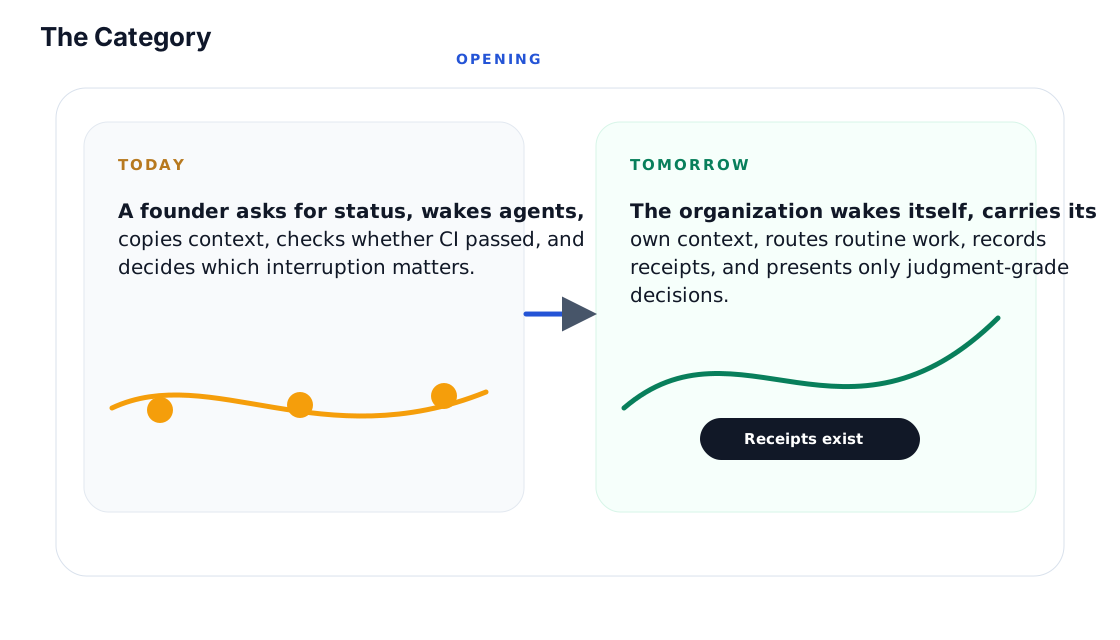
The old world asks how to make a human faster. GLoops asks which routine responsibilities should stop requiring a human at all.
Executive Summary
What this chapter establishes
GLoops turns routine organizational mechanism into governed operational capability while preserving human judgment.
The thesis is the product boundary: the company exists to make autonomous organizations trustworthy, not merely automated.
The autonomous organization is a target; current GLoops capabilities are mostly built or dry-run.
Routine operation runs through governed capabilities with receipts, authority, and inspectable evidence.
Start with dry-run capabilities, earn operational receipts, then prove autonomy before widening authority.
1.1 Humans are the connective tissue — and connective tissue can become software
Section titled “1.1 Humans are the connective tissue — and connective tissue can become software”Every organization contains work that repeats. Some is simple, some complex; some appears to require judgment only because context is fragmented, memory is poor, evidence is hard to assemble, or execution requires a human to coordinate across tools.
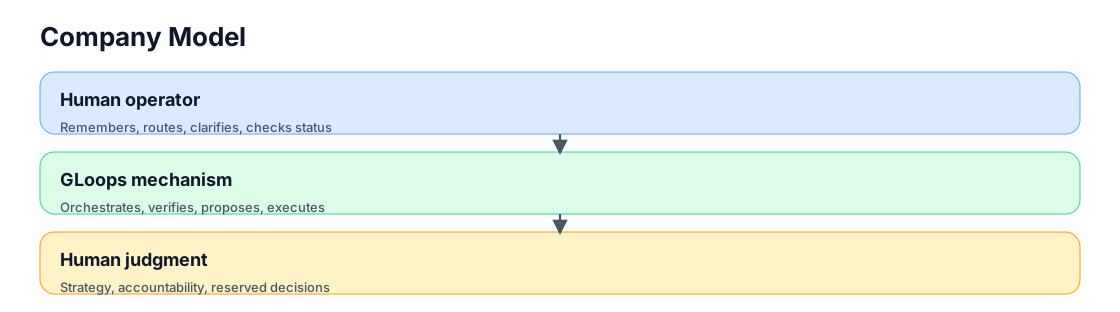
Today the human is that coordinator. They remember what was decided. They remind. They route work between systems. They clarify ambiguous requests. They check whether the build passed. They decide what happens next. An autonomous organization is not an organization with no humans — it is an organization where humans are no longer the mechanism for routine operation. Human work does not disappear; it moves upward — into judgment, creativity, relationships, strategy, leadership, and accountability — while GLoops absorbs the orchestration, coordination, memory, verification, monitoring, routing, and evidence-gathering beneath it.
The company exists to answer one question:
What parts of running an organization should no longer require executive or operator attention?
The answer is not a chatbot, a workflow builder, or a collection of agents. The answer is an operating system for autonomous organizations.
1.2 The Central Rule and the standard of truth
Section titled “1.2 The Central Rule and the standard of truth”The company’s foundational discipline is a single rule, stated three ways so no reader can miss it:
The Central Rule. If the human is still the mechanism, the capability does not exist yet.
- As a rule about the word exists: a capability exists only when its intended organizational outcome has been demonstrably achieved — not when code is written, tests pass, a PR is open, or a Work Order is “issued.”
- As a rule about burden: the outcome standard for any capability touching a recurring human dependency is burden actually removed — no human wakes it, dispatches it, monitors it, triggers it, relays its context, or prompts it to continue. A surface nobody uses is not burden reduction.
This is why the company grades everything Built → Operational → Proven → Blocked (see Govern: Authority, Honesty & Review) and why “PR opened” is never a success claim. Outcomes are the only currency.
| Means the artifact exists | Means the outcome exists | |
|---|---|---|
| Invalid success claim | “PR opened.” · “Work Order issued.” · “JSON generated.” · “Scheduler exists but is off.” · “Capability built but not consumed.” · “Comment posted but no follow-up.” | — |
| Valid success claim | — | “The executive no longer performs this routine step.” · “A Ready issue was clarified without the executive.” · “A PR blocker became execution without the executive.” · “Hermes executed the follow-up and returned receipts.” |
1.3 Why operational capability, not automation
Section titled “1.3 Why operational capability, not automation”Automation scripts a known path. A governed operational capability is durable, evidenced, and earns the right to act:
| Automation / workflow | Governed operational capability | |
|---|---|---|
| Defined by | A script / a fixed path | Intent + contract — what it observes, may propose, what authority it needs, how success is verified |
| Trust model | Trusted because it ran | Earned through evidence, revocable, fail-closed |
| When it errs | Fails silently or barrels on | Escalates; produces a receipt; stops at its authority ceiling |
| Improves by | A human edits the script | Its own evidence — receipts → constraints → grounded knowledge → rising readiness |
| Visible as | Logs | Evidence + immutable Receipts — the trust substrate |
Five lenses — Operational Capability vs. Automation
| Lens | |
|---|---|
| ▣ Current Reality | GLoops runs a small number of capabilities (Issue Clarification, PR Review) in dry-run — code-aware reasoning and verifiers exist; nothing acts on the real world yet. |
| ◇ Target State | Every recurring operational responsibility is a capability with a contract, an authority level it has earned, and a stream of receipts proving its behavior. |
| → Migration Path | Build the capability in dry-run → produce receipts → reach operational on real targets → reach proven by independent audit → earn more autonomy one rung at a time (see Runtime Architecture). |
| ⚖ Executive Implication | You are never asked to trust a black box. Autonomy is earned, scoped, and revocable in conversation; you can stop any capability at any time. |
| ☼ Operator Experience | You stop performing the step and start governing it — approving, scoping, and occasionally correcting, with every action evidenced. |
Chapter closeout
Decision ledger
Key Decisions
- The Central Rule governs every success claim.
- Operational capability is not a fixed automation script.
Open Questions
- Which SDLC responsibilities cross from dry-run to operational first?
Related
- Operational Role
- Govern: Authority, Honesty & Review
- Role Replacement Program