The Unit of Transformation: the Operational Role
Executive Summary
What this chapter establishes
The portfolio optimizes for replacing operational roles, starting with the SDLC Orchestrator.
Task automation can leave tomorrow unchanged; role replacement changes the organization.
Full-role standing replacement is ~40–55% (six of seven weighted orchestration streams run unattended in production for covered Induct issues); remaining gaps are deployment-proof, dry-run receipts, and the learning loop.
Routine SDLC orchestration runs without the executive; product judgment and reserved authority remain human.
Replace responsibilities in evidence-gated order and report replacement percentage plus Role ROI.
Early thinking optimized burdens, tasks, and individual capabilities one at a time. That was useful but insufficient. The correct unit of transformation is the Operational Role.
A human operational role is a recurring bundle of responsibilities. Replacing one burden rarely changes the operator’s day; replacing a role changes the organization. So the question is never “what feature should we build?” but:
Which responsibility of which operational role can become governed capability next?
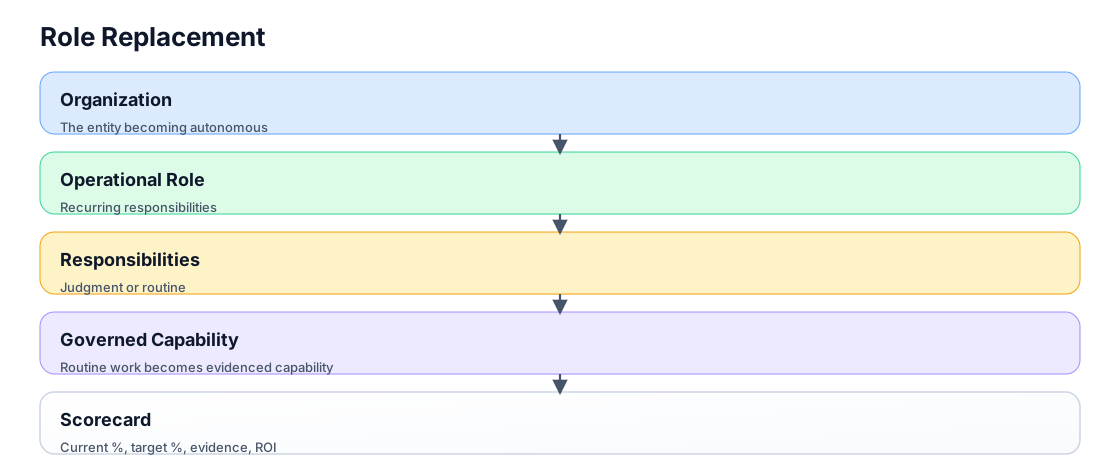
Every capability must map to a role responsibility. Every Work Order must state which responsibility it advances. Every report must answer how role replacement changed. Every execution cycle must explain why the selected investment beats the next-best use of engineering capacity.
The immediate target is precise — and precise about what it is not:
Replace the executive as the SDLC Orchestrator for Induct. Not as product owner. Not as executive. Not as final judgment. Replace the executive as the operational mechanism that moves software delivery forward.
The test that governs every prioritization decision:
The CEO test: If the CEO did not show up tomorrow, what would still happen? That question measures autonomy better than any feature count. (See the Role Replacement Program for the full SDLC Orchestrator scorecard, and Success Metrics for how this becomes the primary success metric.)
Five lenses — Role replacement as the unit
| Lens | |
|---|---|
| ▣ Current Reality | SDLC Orchestrator is ~40–55% replaced as standing operation (past the earlier <25%): most routine orchestration for covered Induct issues now runs unattended in production; gaps are deployment/standing-proof, dry-run receipts, and the learning loop. |
| ◇ Target State | 90%+ of the role’s routine responsibilities run as governed capabilities; the executive handles only product judgment, priority tradeoffs, reserved authority, and accountability. |
| → Migration Path | Allocate engineering capacity to the highest-return role-replacement investments, then execute the smallest safe slice inside the selected investment. Each completed investment lifts the role’s replacement percentage and reports Role ROI. |
| ⚖ Executive Implication | Progress is measured by role replacement delta, not shipped features. A slice that produces artifacts but leaves the role unreplaced is motion, not progress. |
| ☼ Operator Experience | Each phase removes a recurring step from your day. The win is felt as “I no longer do X tomorrow,” not “a new screen exists.” |
Part II — The Architecture
Section titled “Part II — The Architecture”Chapter closeout
Decision ledger
Key Decisions
- Role replacement, not isolated burden removal, is the optimization unit.
Open Questions
- Which responsibility produces the highest role-replacement delta once runtime substrate is stable?
Related
- Role Replacement Explorer
- Role Scorecards
- The Transformation Roadmap