The Transformation Roadmap
Executive Summary
What this chapter establishes
The roadmap organizes work into five executive programs rather than a feature backlog.
The roadmap is five executive programs, not a feature list. Each answers the same eight questions, so an executive can read any phase and know what it costs, what it changes, and how it’s judged.
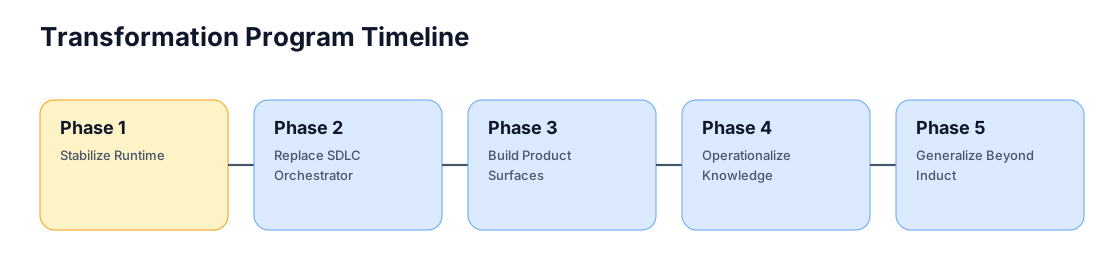
Phase 1 — Stabilize the Runtime
- Purpose: GLoops can execute work without the executive as the trigger.
- Operator change: work starts because an event fired, not because the executive prompted.
- Capabilities: ExecutionRequests · Hermes runner · Work Order ingestion · scheduler/event substrate · receipts · status · basic Action Queue.
- Success criteria: work starts without prompting · status is visible · receipts exist · stalls surface automatically.
- Review gates: Operational Gate on each runtime capability.
- Expected burden reduction: the executive stops being the event bus and dispatcher.
- Role replacement delta: unblocks responsibilities 7–8, 16.
- Product surfaces: basic Action Queue, status.
Phase 2 — Replace SDLC Orchestrator for Induct (the headline phase)
- Purpose: the executive no longer runs Induct’s SDLC.
- Operator change: the executive handles only true product judgment and Go/No-Go.
- Capabilities: issue discovery · understanding · clarification · planning · implementation dispatch · verification · adversarial review · PR readiness · merge readiness · blocker resolution.
- Success criteria: Ready issues understood · clarifying questions drafted/posted · build plans prepared · implementation starts · PRs include evidence · blockers trigger follow-up.
- Review gates: Burden Gate on each responsibility; scorecard updated each slice.
- Expected burden reduction: the bulk of the SDLC Orchestrator role.
- Role replacement delta: the primary metric — drive ~40–55% → 90%+.
- Product surfaces: Capability Portfolio, Action Queue, Role Replacement Dashboard.
Phase 3 — Build Product Surfaces
- Purpose: the executive interacts through GLoops and Ralph, not chat.
- Operator change: the executive opens GLoops to see work and opens Ralph to decide; markdown reports shrink; prompting becomes rare.
- Capabilities: Action Queue · Capability Portfolio · Organization Portfolio · Portfolio Health · Executive Updates · Ralph room.
- Success criteria: the executive opens the products instead of being prompted.
- Expected burden reduction: the recurring
/goalprompting loop itself becomes a surface.- Role replacement delta: makes replacement visible and governable.
- Product surfaces: all of Part IV.
Phase 4 — Operationalize Knowledge
- Purpose: the system remembers.
- Operator change: the executive stops repeating context; agents cite prior decisions.
- Capabilities: GBrain · ingestion · cross-linking · contradiction detection · precedent retrieval · context assembly.
- Success criteria: repeated corrections become capability improvements.
- Role replacement delta: completes responsibilities 17–18.
- Product surfaces: Knowledge Graph, Receipt Explorer.
Phase 5 — Generalize Beyond Induct
- Purpose: GLoops operationalizes new organizations through onboarding, not reinvention.
- Operator change: a second organization consumes capabilities instead of triggering a rebuild.
- Capabilities: organization onboarding · adapter model · capability consumption · role replacement scorecards · organization health · Reference Realization comparison.
- Success criteria: new orgs consume existing capabilities; reference realizations improve the platform; platform improvement benefits all orgs.
- Role replacement delta: proves the flywheel across orgs.
- Product surfaces: Organization Portfolio.
▣ Current Reality of the roadmap. The portfolio is early in Phase 1. The dispatch spine is dry-run (D0); the autonomous scheduler is wired but dormant; zero real receipts exist. Phases are sequential in dependency but the portfolio runs them as parallel streams wherever a stream is unblocked.
Chapter closeout
Decision ledger
Key Decisions
- The roadmap is sequential by dependency but parallel by execution where unblocked.
Open Questions
- When does Phase 1 produce the first operational receipt?
Related
- Transformation Roadmap Figure
- Runtime Architecture
- Role Replacement Program - Scorecard